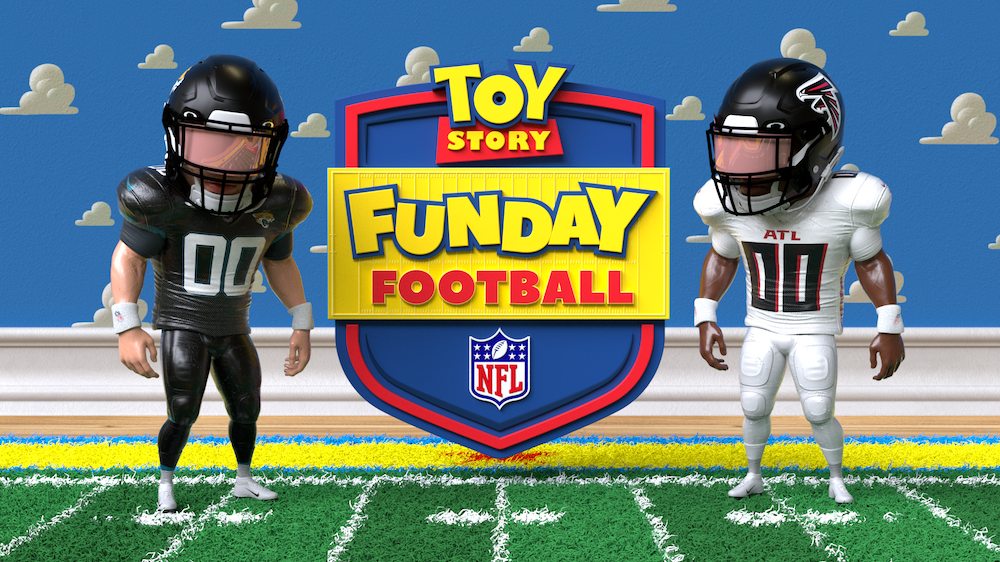
In an unusual yet captivating twist, Sunday’s NFL game between the Jacksonville Jaguars and the Atlanta Falcons, hosted at London’s Wembley Stadium, got the Pixar treatment. Instead of the typical ESPN broadcast, viewers had a delightful choice: the traditional game or a “Toy Story” animated version straight from Andy’s room.
Thanks to a unique collaboration between the NFL, Disney, and Pixar, fans were introduced to “Toy Story Funday Football.” Leveraging innovative tech, chips within player pads, and overhead field cameras, the entire game unfolded in real-time animation. The beloved characters of Toy Story, along with thematic graphics and commentary, dominated this alternative telecast.
To immerse fans entirely, the coverage prominently featured iconic “Toy Story” characters. Slinky Dog dynamically transformed into the First Down chain on the sidelines, while Rex the Dinosaur captivated audiences with in-game analyses. The mischievous green aliens, always obsessed with “the claw”, operated the skycam, and fittingly, the revered claw machine took on the critical role of spotting the ball for each play. As a half-time treat, daredevil Duke Caboom put on an exhilarating performance.
ESPN’s Creative Studio was behind the genius design of both the animated football players and the on-air cartoon personalities calling the game. This talented roster included Drew Carter, Booger McFarland, and young prodigy Pepper Persley. While Beyond Sports masterfully animated the players, the broadcasting talent was brought to life by Silver Spoon animation, thanks to the marvel of motion-capture suits.
Michael Szykowny, ESPN’s Senior Director of Animation, Graphics Innovation & Production Design, expressed the enormity of this venture. He highlighted, “This is a monumental fusion of cutting-edge technologies with two powerhouse brands – Toy Story and the NFL. Our goal was to ensure we maintained the integrity of both brands in terms of technicality, visual appeal, and storytelling.” He added, “The essence of the NFL game remains unchanged. Our objective was to showcase it authentically within this whimsical atmosphere.”
The objective of this for the NFL was simple, to introduce a young new audience to its product. Football’s physicality is not conducive to family viewing, but this approach helped address this. While time will tell if this helps grow the game with younger audiences, the initial feedback is promising.
The broadcast, though ambitious, was largely met with positive feedback. Initial teething problems were swiftly addressed, paving the way for a seamless, entertaining experience for the remainder of the game. A lot of social posts showed kids around the US excitedly watching the coverage.
While the glitches may have impacted some people’s enjoyment, the technical marvel that the NFL and ESPN have been able to deliver is astronomical. Motion capture typically takes a few days to several weeks, or even months, depending on the number of animations to produce. This coverage was able to do this in almost real-time, and at scale with 22 players on the field at any one time.
While this is unlikely to replace how people view sports coverages in the future, it is technically amazing and a glimpse into what the future holds with technological advancement. Real-time motion capture and augmentation will likely have a lasting effect on live event coverage.